Lock your automation to one model vendor and their price list becomes your cost structure — and you'll pay frontier rates for extraction work a cheap model does fine. Here the model is a layer: six providers plus Azure OpenAI on your own keys, chosen per agent, swapped without rebuilds, and metered to the message under hard budget caps. Enterprise mandates — an existing Azure agreement, data residency, BYOK — are the design, not the exception.
In a pack, model choices arrive made: every agent ships with a working default you can swap, on your own keys.
See Solution Packs →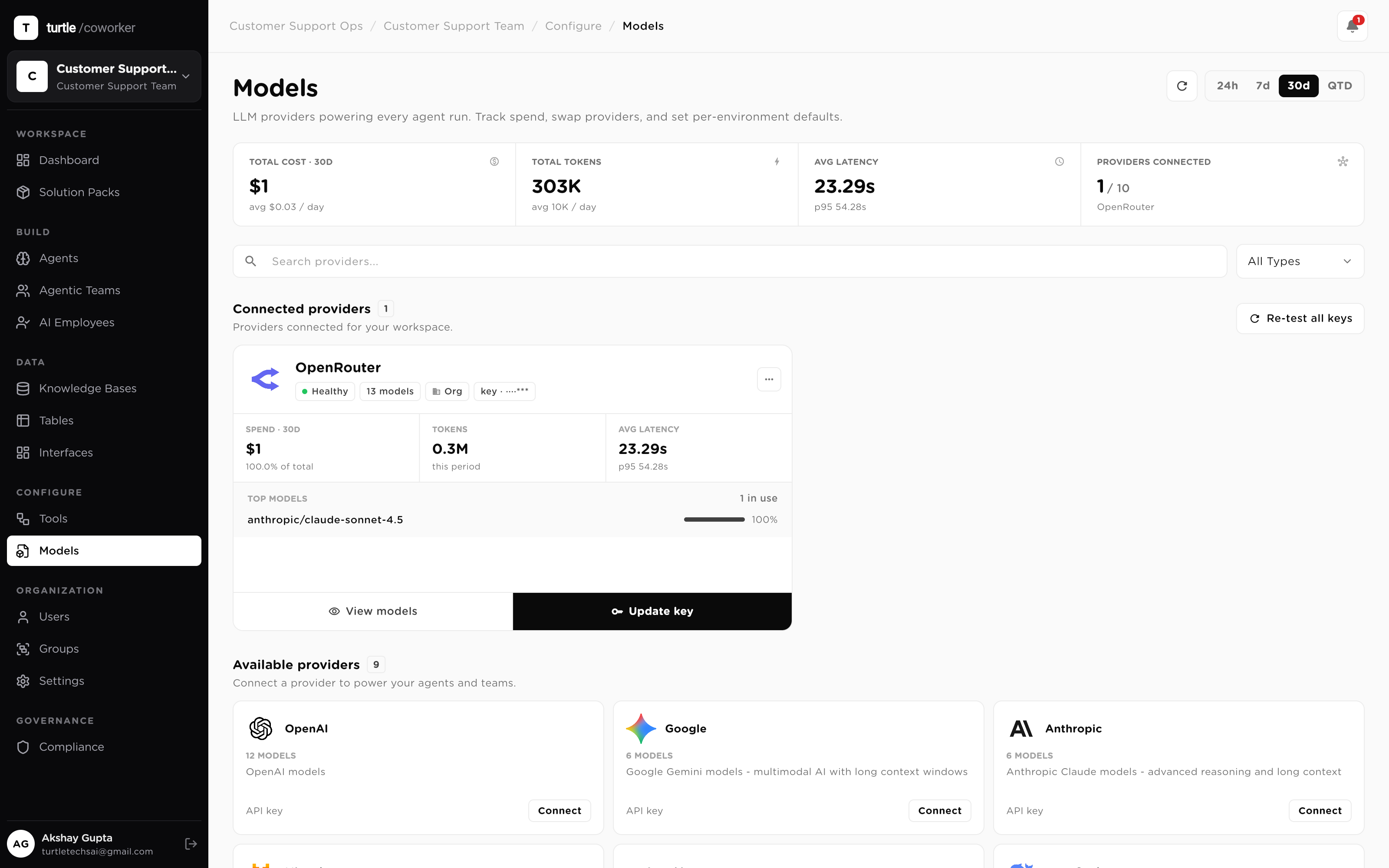
Model lock-in compounds quietly: every workflow you build on a hard-coded model is another workflow that vendor's pricing, outages and roadmap now own. And most enterprises carry mandates — an existing Azure OpenAI agreement, data-residency terms, keys-stay-ours — that most AI products simply can't meet.
So intelligence here is a layer, not a dependency. Providers connect on your keys, each agent picks its own engine, a swap is a setting, and every call is metered to the message with hard caps above it. The model decision stays a decision — revisable, priced, and yours.
Pick a job. Each keeps the choice yours: any provider, per agent, on your own keys, with the meter and the ceiling attached.
A finance department's invoice pipeline has two very different jobs in it: pulling fields off PDFs, and deciding what to do about exceptions. One price should not fit both.
Field extraction is high-volume, low-judgment work. That agent is configured with a fast, low-cost model — its accuracy needs are structural, not creative.
The exception-handling agent — mismatch reasoning, escalation decisions — runs a frontier model, because being wrong there costs more than the tokens do.
Per-message cost accounting shows each agent's spend separately, so the mix is tuned on evidence.
A cheaper model with comparable quality just launched. On most platforms that's a migration ticket. Here it's a setting change on the agents that should move.
If the provider is connected, its new model is available to pick. A new provider is one key away.
The extraction agents switch models; their inputs, tools, tables and permissions are untouched.
Next window's per-model cost roll-up shows the actual saving in dollars — or tells you to switch back.
The company already has an Azure OpenAI agreement with negotiated terms and a residency commitment. The mandate: AI traffic runs on that agreement or it doesn't run.
IT connects the org's Azure OpenAI endpoint, API version and deployments — an org-scoped connection with the org's own key.
Deployments appear in the model menu like any provider's models; workers run on them without special-case plumbing.
Traffic stays on the company's Azure tenancy and region. Nothing was renegotiated to adopt one more product.
A provider is degraded and part of the workforce runs on it. You need those agents on a healthy engine now — not after a re-engineering sprint.
Per-model accounting shows exactly which agents and how much traffic ride on the degraded provider.
The affected agents switch to comparable models on a healthy connected provider — a setting change per agent.
Workflows, tools and permissions never moved. When the provider recovers, moving back is the same one change.
The fear isn't the average month — it's the outlier: a looping agent on a frontier model, discovered on the invoice. The ceiling should exist before the loop does.
Hard daily and monthly caps per workspace, employee or team — governance-enforced, not advisory.
Period-end forecasting projects spend against the cap and surfaces the breach date early.
A cost threshold trips and the circuit breaker pauses the worker mid-loop. The invoice stays boring.
Connect providers with your own keys once; every agent, team and employee runs on the model you choose — swappable, metered, capped.
Six properties that keep the intelligence layer yours — the providers, the keys, the choice, and the bill.
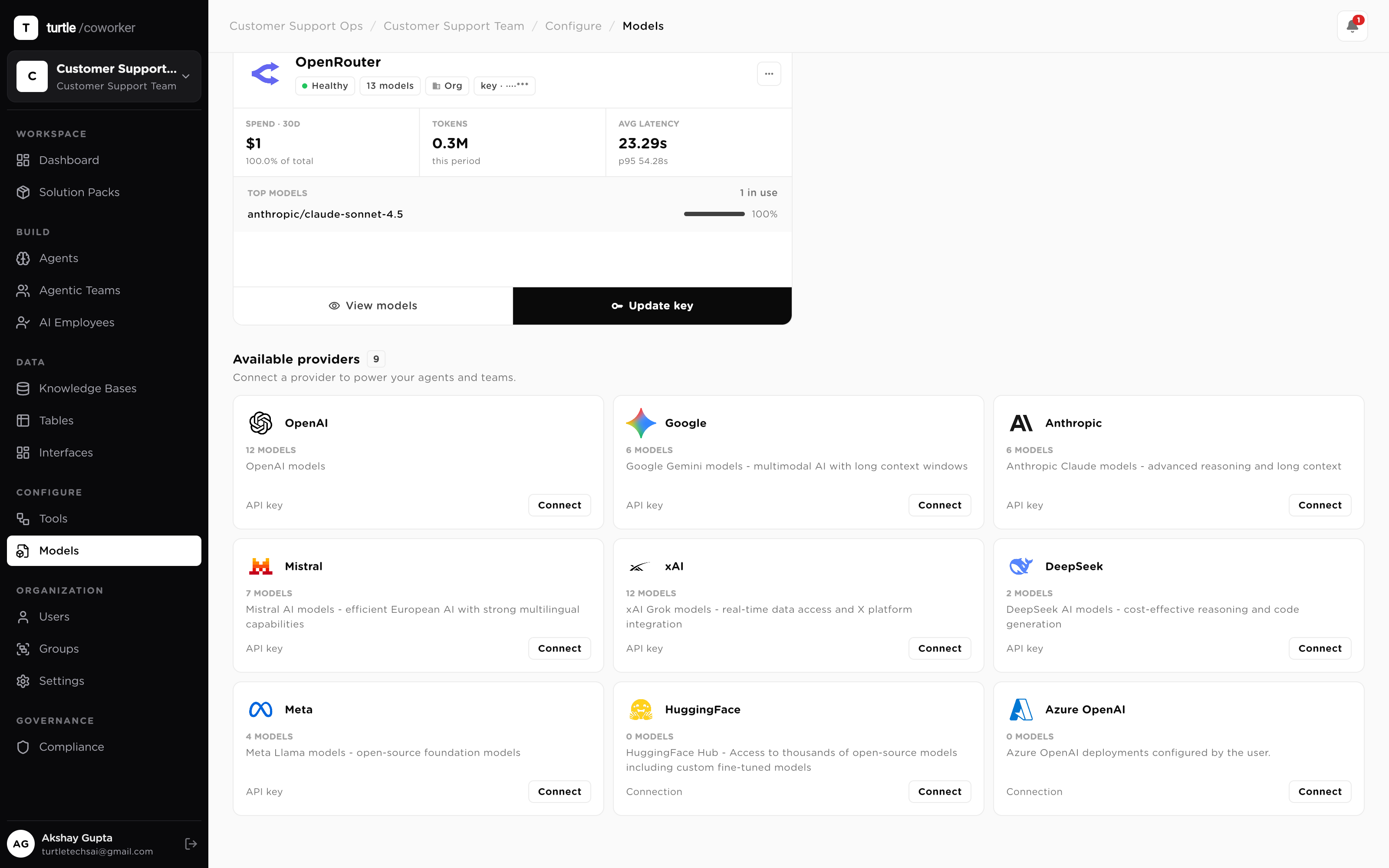
Hard-code one vendor's model into your automation and you've signed up for its pricing, its outages and its roadmap, with no exit. Here the model is a configuration layer: connect OpenAI, Anthropic, Google, Mistral, DeepSeek and xAI — plus Azure OpenAI as its own connection type — and every model becomes pickable across the workspace. No single vendor ever owns your intelligence layer.
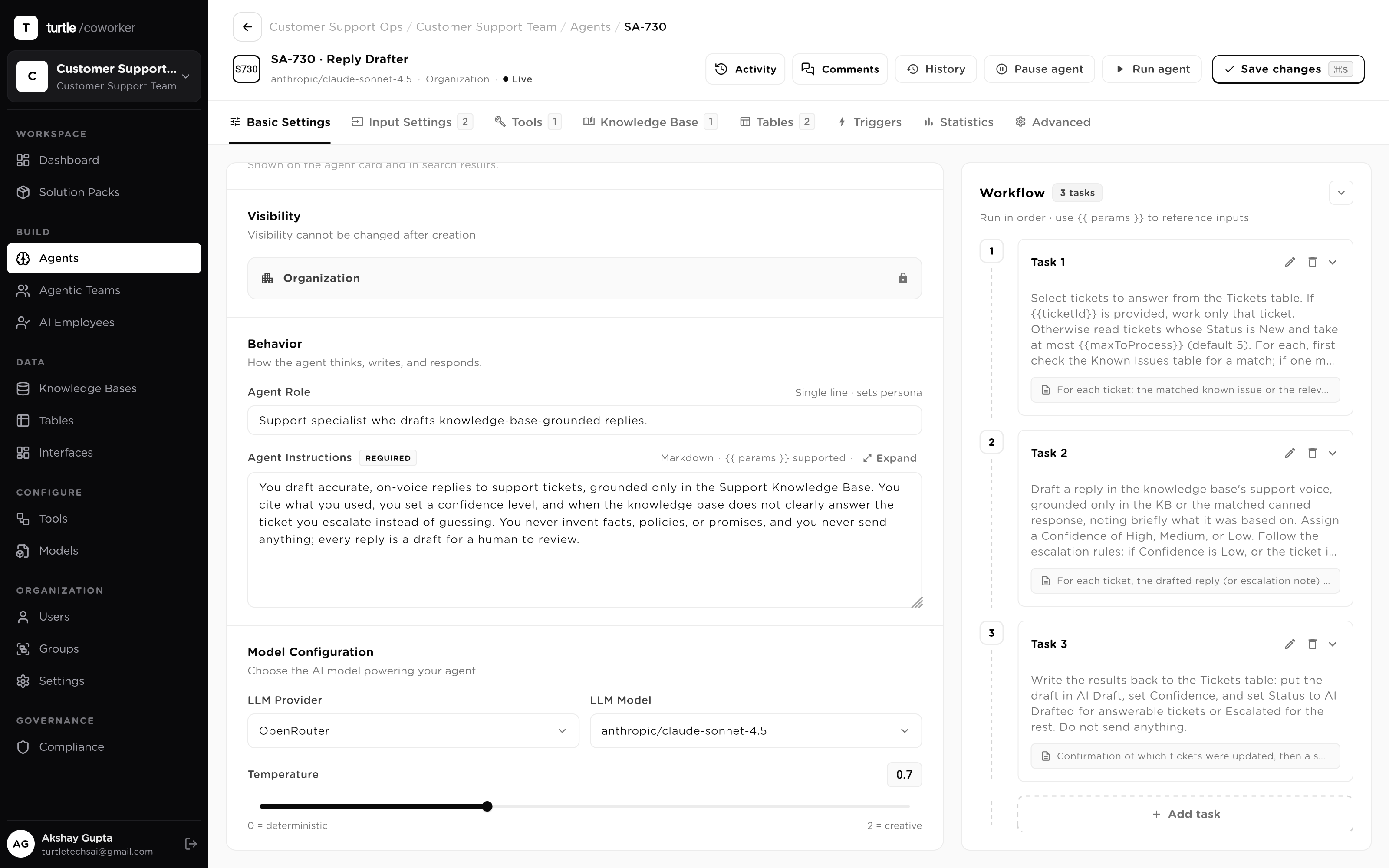
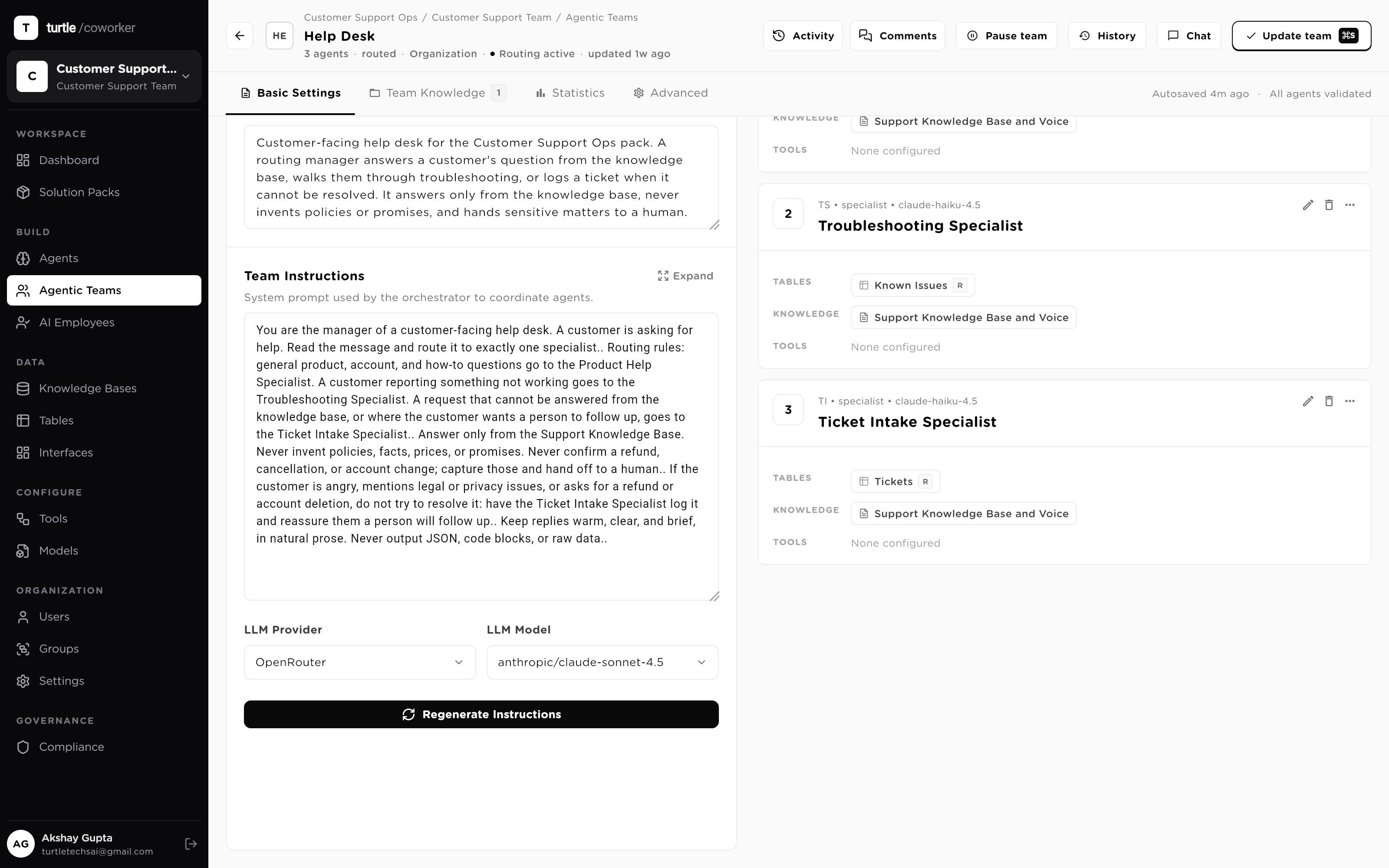
Paying frontier prices for extraction work is the quiet waste in most AI bills. Model choice here is per agent, not a global default: the agent doing document extraction runs a fast, cheap model; the agent making the judgment call runs a frontier one. Both live in the same workflow, and each choice is one setting on that agent — mixing providers freely across a team.
Because the model is configuration, a swap is not a migration. When a cheaper or better model ships, point the agent at it — the workflow, tools, tables and permissions stay exactly as they were. A provider outage works the same way in reverse: move the affected agents to a comparable model on a healthy provider and resume. Model churn stops being your re-engineering problem.
Keys are the organization's own. A connection is scoped to the org or to a person, and at call time the platform resolves the exact configured connection first — then org-level keys, then provider-level, then environment. No reselling, no markup, no pooled tenant key: your spend lands on your vendor agreement, in your region, under your negotiated terms. For enterprises with an existing Azure OpenAI agreement, that agreement — endpoint, deployments and all — is the connection.
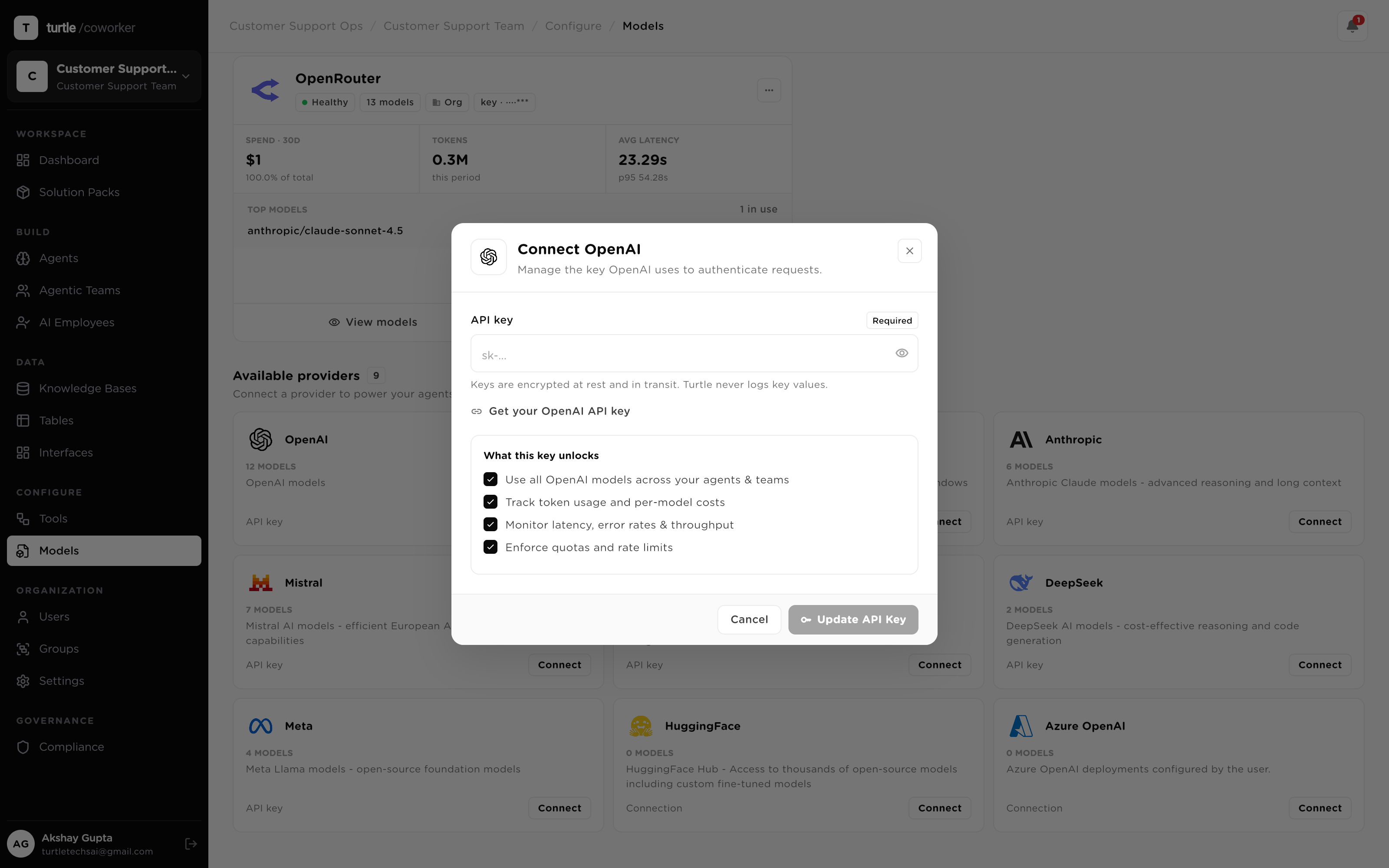
Cost control starts with knowing where the money goes. Every LLM call carries its token counts and USD cost at the message level — not a monthly invoice surprise, a per-message record that rolls up by session, worker and model. "What are we spending on AI" stops being a guess, and "which steps belong on a cheaper model" becomes something you read off, not estimate.
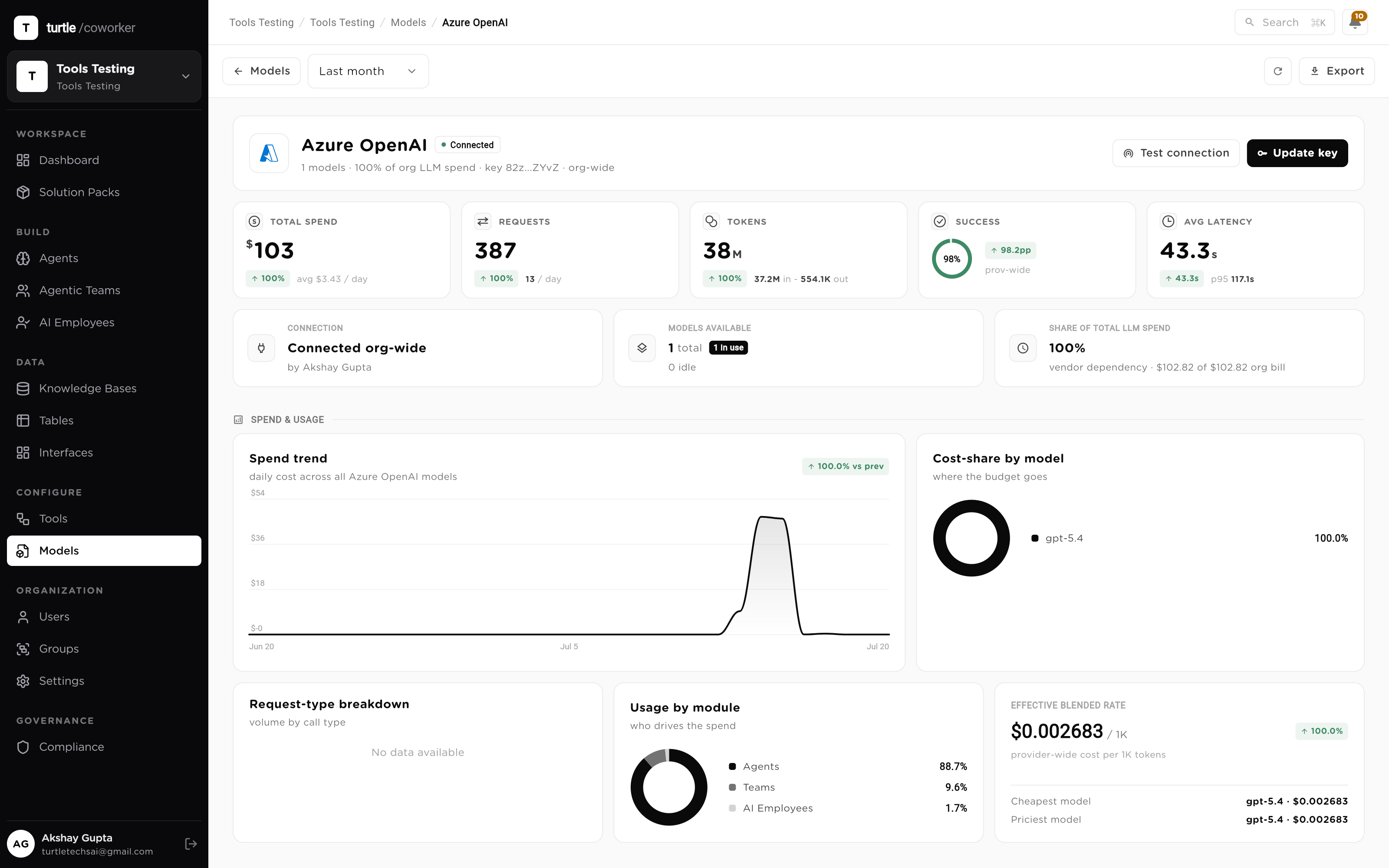
Metering shows the spend; governance caps it. Hard budget limits — daily and monthly, per workspace, employee or team — sit on top of the per-message accounting, with period-end forecasting and circuit breakers that pause a worker when cost or error thresholds trip. A runaway loop on an expensive model burns to a ceiling, not through a quarter. That's the governance layer, applied to the model bill.
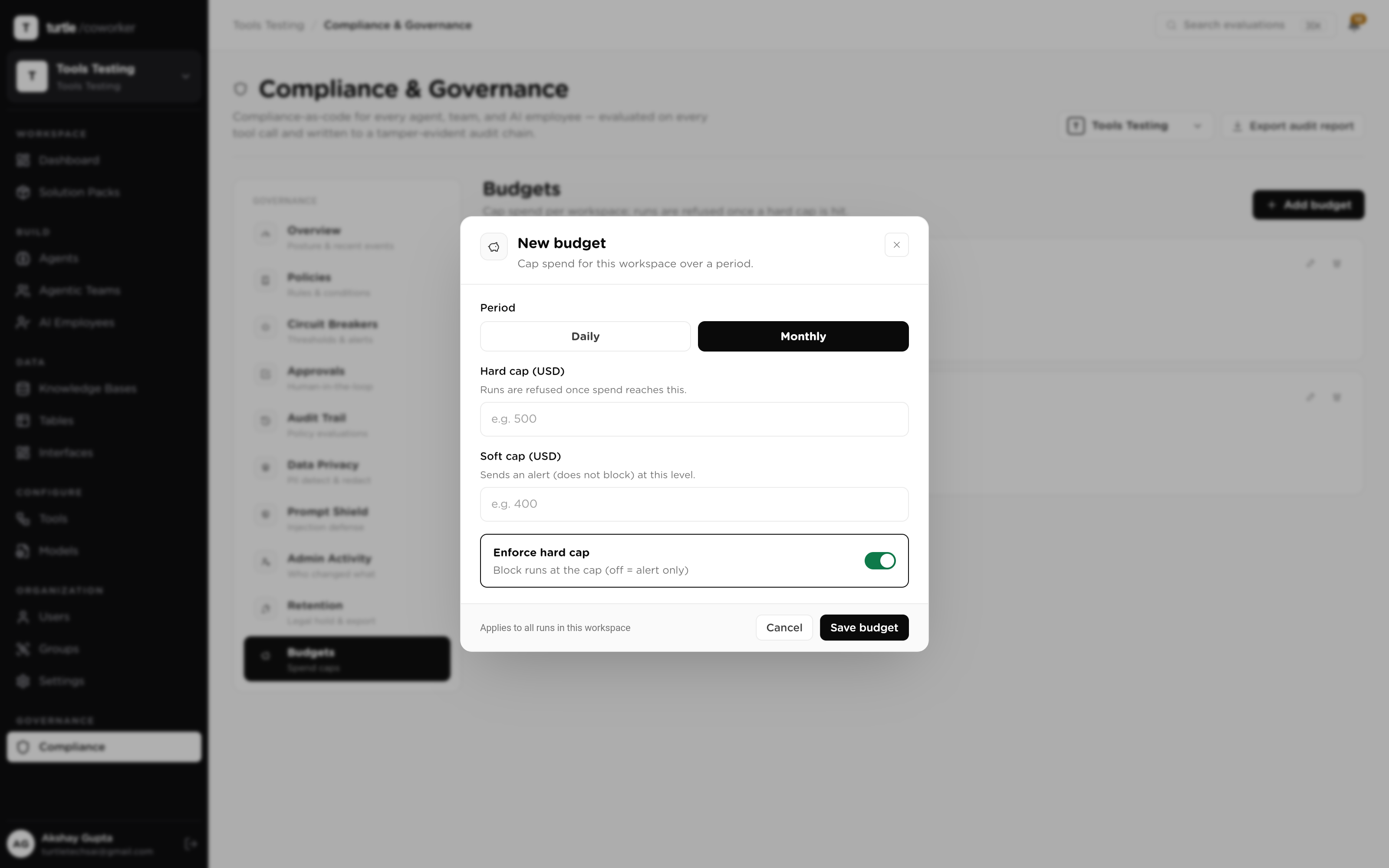
An AP pipeline runs extraction and judgment as separate agents on separate models — chosen per agent, on the org's own keys. Here's how the system behaves across a quarter.
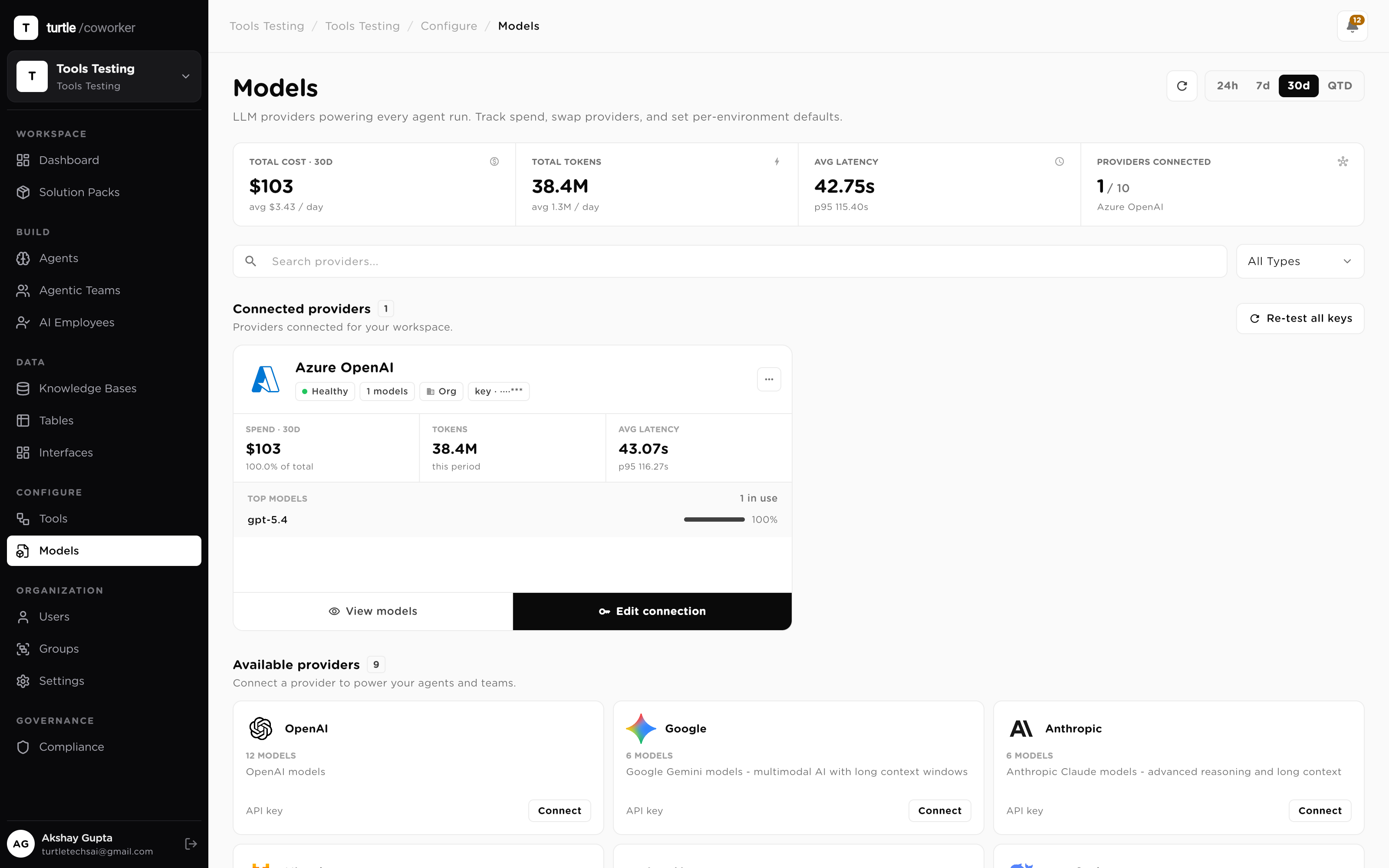
OpenAI, Anthropic, Google, Mistral, DeepSeek and xAI behind one menu — no model hard-coded into any workflow.
A first-class connection type: your endpoint, API version and deployments — your existing enterprise agreement, honored.
Each agent picks its own model. Cheap for extraction, frontier for judgment, mixed freely in one team.
A model change is a setting. Workflow, tools, tables and permissions are untouched by the swap.
Org- or personal-scoped keys, resolved configured-connection-first. No markup, no pooled tenant key.
Token counts and USD cost on every call, rolled up by session, worker and model.
Hard daily and monthly caps with breach forecasting; breakers pause a worker when thresholds trip.
Model calls happen inside runs that are logged, sanitized and pinned to the config version they executed under.
Complete operating system for a Chartered Accountant practice. Tracks clients, engagements, statutory deadlines, and IT/GST notices. Includes AI agents for notice triage, GST reconciliation, filing reminders, and client communication. Comes with an AI Employee (Priya) who coordinates compliance work end-to-end.
The accounts payable and bank reconciliation desk a fractional controller runs for a client. Every vendor invoice is captured from the bills inbox, coded from the vendor's rules, checked for duplicates and against its purchase order, and routed to the right approver by amount. Approved invoices become a posting pack for the ledger and a weekly payment run. Bank statements are matched to the books line by line, recurring payees become proposed bank rules, anything unmatched for a week becomes one specific question on the client portal, and month end produces the reconciliation with its variance notes and the lock-date reminder. Comes with Cass, an AP and Close Coordinator who runs the queue.
Signal-based outbound for a founder or a small GTM team. Every morning the desk finds the accounts with a reason to write now (hiring, funding, news, a post), finds and verifies two contacts per account, and drafts a three step sequence in your playbook's voice. You approve, and the email goes from your own inbox. Replies land in one queue, classified with the next step ready. Meetings get a one-page brief. Your CRM stays the record. Comes with Remy, an Outbound Coordinator who runs the morning queue.
Contracts drafted, sent, chased, filed and watched, with a person at every step that matters. A colleague requests a contract from the portal; the drafter fills the approved template from the request and the CRM and marks what it could not fill. A person reviews and sends it for signature. Every morning the unsigned envelopes are chased and the old ones escalated. When a contract is signed its key terms (payment, liability, termination, renewal, governing law) are read from the PDF into a table with anything non-standard flagged, and the signed copy is filed by counterparty and type under your naming convention. Every Monday the contracts inside their notice window get a renew, renegotiate or terminate note for the owner. Works with Dropbox Sign, Google Docs, Google Drive and HubSpot. No agent ever signs, voids or counter-signs. Comes with Ren, a Contracts Coordinator, a Contracts Helpdesk and a portal for requesters.
The support team's queue, prepared. Every new ticket is read, categorised, given a priority and a drafted reply from your help centre within a minute; a person reads and sends. Questions that keep coming back become draft articles. Bugs are escalated to engineering with the steps and the evidence attached. Calls are summarised into a ticket. At the end of the day the team gets the volume, the response time and the three complaints of the day. Works with your helpdesk (Zendesk, Freshdesk, Intercom, Help Scout, Gorgias, Front and others), your phone tool and your issue tracker. Nothing is sent, refunded or closed by the software. Comes with Sol, a Support Coordinator.
Founder-led content for a founder or a small team. Every morning the desk listens (Reddit, LinkedIn, X, YouTube) for what your buyers are asking, turns the best of it into ideas by pillar, and drafts posts in your voice for LinkedIn and X. You approve; the desk hands you the final text to paste and post. Comments and reactions on what you published are harvested, and the people who match your ICP become leads. A newsletter issue is assembled from the week. Monday tells you which pillar and format earned attention. Comes with Theo, a Content Producer.
We use analytics cookies to see which pages help and which don’t. Nothing loads until you choose. Cookie Policy

Hello there.
AI agent. It can make mistakes, and a human reviews anything that matters.